


30 Jun PhD thesis
In January 2023, the time had come: after more than three years of intensive effort, I submitted my dissertation. And at the end of february of the same year, I successfully defended it.
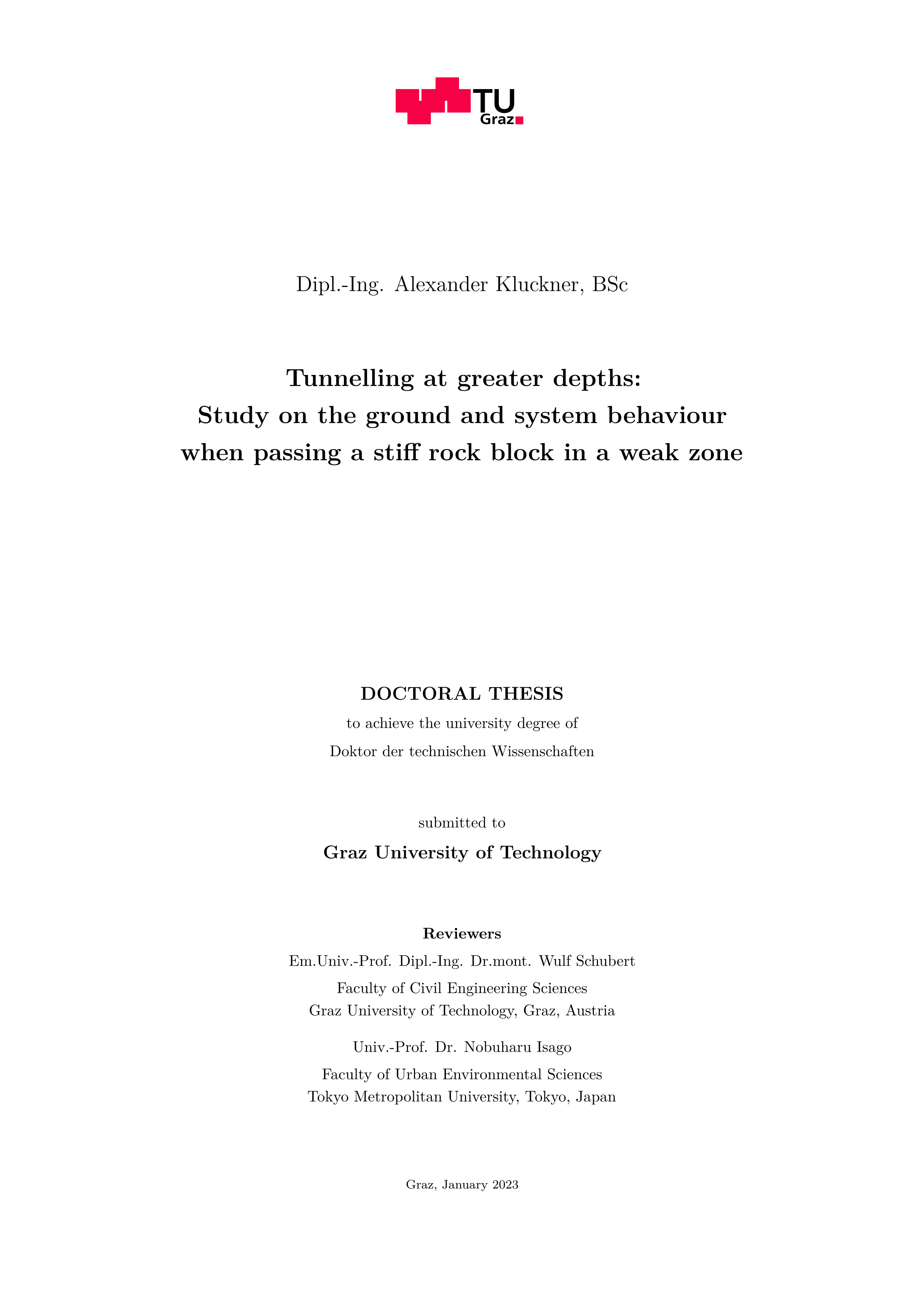
Title:
Tunnelling at greater depths: Study on the ground and system behaviour when passing a stiff rock block in a weak zone
Short abstract:
Large, rigid rock blocks can be encountered when tunnelling through fault zones. These can be problematic because they attract stresses and can fail near the excavation. The dissertation examines the influence of such blocks on rock mass and system behaviour. Measurement data from the Semmering Base Tunnel was available for calculation calibration and result validation..
Keywords:
deep tunnelling, conventional, brittle fault zone, block-in-matrix, stiff block, shear bands
Download:
https://doi.org/10.3217/74t5y-8xe19
Abstract:
A stiff block in brittle, weak fault zones can lead to unfavourable ground behaviour when being approached by a tunnel drive. It attracts stresses and may fail when it is close to the tunnel face endangering the tunnel stability. The thesis investigates the ground behaviour with a quasi-two-dimensional parametric study. The tunnel diameter is 10 m, the block height is 2 m, 5 m, or 10 m, and the distance between the block and the tunnel is 1 m, 5 m, or 10 m. One critical case is analysed in three dimensions. Another study simulates a real tunnel drive that crosses a block with a height of over 25 m. Strain data from a lining segment measured at the construction site with a distributed fibre optic sensing system is used to set up the Burgers-Mohr model simulating the shotcrete material behaviour. All simulations consider an interface between the block and the matrix material. From the block, shear bands form towards the tunnel. In the parametric study, even if the block-matrix stiffness contrast is high or the block is close to the tunnel, differences in the tunnel displacements between cases with block and related cases without block are little. Of the cases analysed, those with a hydrostatic primary stress state are least favourable. If the primary stresses are anisotropic, the effect of the block on the ground behaviour strongly depends on the block distance. The case study suggests that the block must be not too high to be hazardous if it fails. Otherwise, stresses redistributed because of the tunnel drive cannot concentrate at the block’s top and bottom. In case the stresses are high enough at the moment of block failure, large-scale shear failure of the rock mass close to the tunnel may occur. If the location of blocks is unknown, state-of-the-art approaches to evaluate tunnel displacements must be applied to increase the probability of identifying blocks in time during tunnelling. Making the system stiffer of less stiff (e.g., by adapting the moment of ring closure) may not lead to a less hazardous situation. It is advised to minimise the unreinforced rock mass volume close to the tunnel face to prevent shear bands from reaching the tunnel.
The main part of the dissertation contains the following chapters:
1. Introduction (PDF file)
2. About fault zones and block-in-matrix rocks (PDF file)
3. Some properties of rocks and rock masses (PDF file)
4. Some characteristics of shotcrete (PDF file)
5. Thermo-chemo-mechanical shotcrete model (PDF file)
6. Stiff block next to excavation (2D): Parametric study (PDF file)
7. Stiff block next to excavation (3D): Supplementary study (PDF file)
8. Fibre optic monitoring section: Data evaluation (PDF file)
9. Fibre optic monitoring section: Calibration case (3D) (PDF file)
10. Stiff block next to excavation (3D): Validation case (PDF file)
11. Discussion (PDF file)
12. Conclusion (PDF file)